Low-Code Process Design with JobRouter®
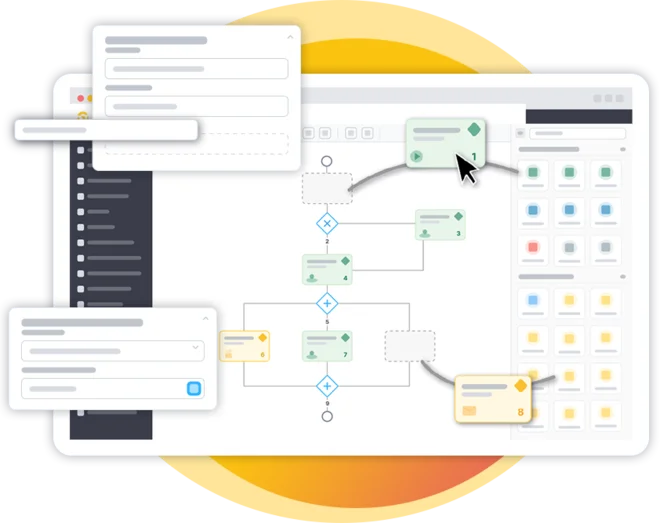
JobRouter® is a low-code digitalization platform that enables you to automate your processes with minimal programming knowledge. Find out here how low-code process design can improve flows within your company and why low-code software such as JobRouter® can help you to achieve your goals quickly.
Functions of the JobRouter® Low-Code Platform
JobRouter® is a low-code process automation software package. Our clients and partners benefit from the low-code development offered by JobRouter® that enables them to digitalize applications and business processes independently in record time. This is possible thanks to standard functionalities, modules and finished elements. Users can develop applications using drag and drop and with the help of low-code programming. Immediately accessible functionalities such as user management and workflow control are available in addition to a form designer.
Overview of Functions
Simple creation of interactive forms
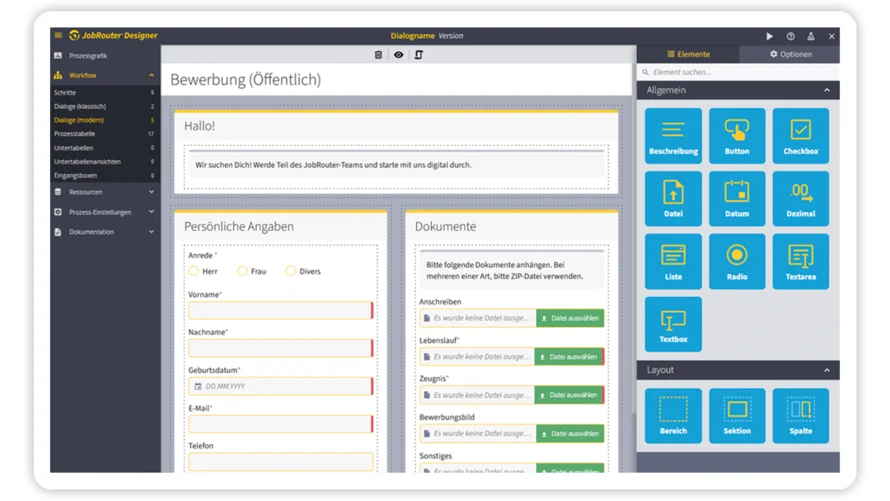
The integrated form designer allows you to create forms in no time. These electronic forms create an interface between the JobRouter® system and the user. They provide information and allow you to work on process data.
Wide range of form elements
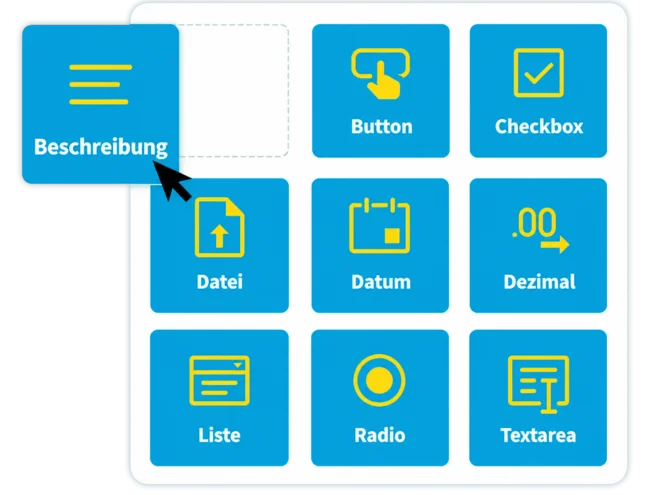
You will have access to a wide range of form elements. All elements can be easily added to the corresponding form. Typical elements include text fields, lists, radio buttons, checkboxes, buttons, attachments, files, images, etc.
Building and automating process flows
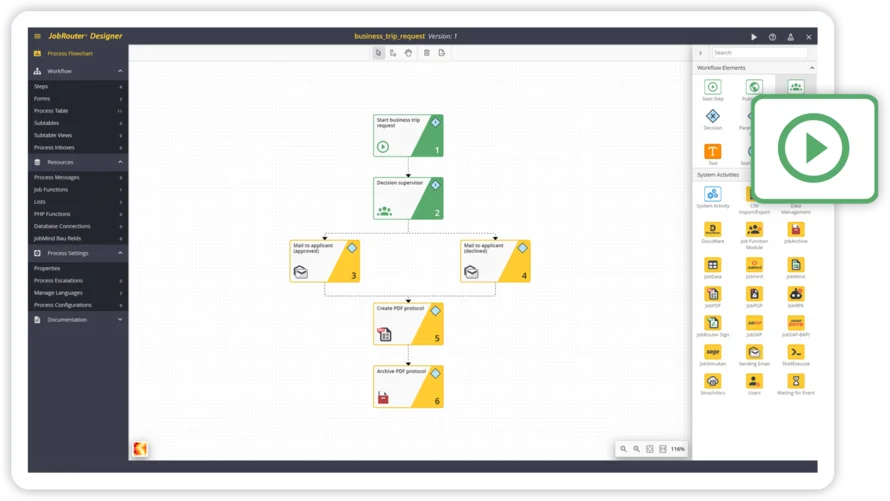
You can use the integrated, visual flowchart designer to establish your application’s business processes and flows. You can then automate the flows with the JobRouter® workflow engine. By observing business rules and escalation procedures, you can ensure that the workflow is implemented correctly.
Importing existing BPMN models
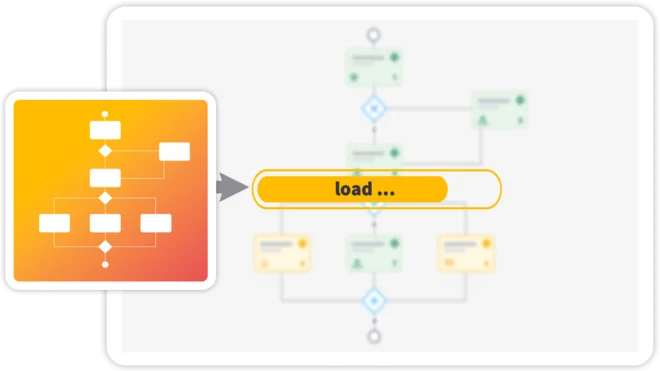
You may have already created workflows using the process notation language BPMN and may want to use them as a basis for your digital processes in JobRouter®. No problem! The BPMN importer allows you to import your existing model and transform it into a JobRouter® workflow. You can use our BPMN converter to create a JobRouter® flowchart from your BPMN file.
Adapting and managing data
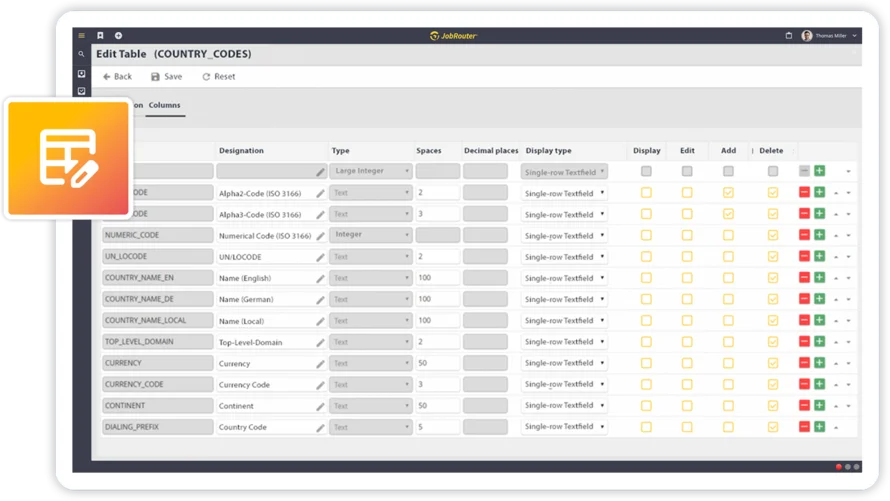
Data forms the basis of all applications. The JobRouter® digitalization platform enables you to create data containers without any knowledge of databases. You can use these data containers to store and manage important data, such as lists of customers, suppliers, and cost centers, for all your applications. Thanks to seamless integration in the JobRouter® user administration, individual rights can be defined for the viewing, editing and processing of these data records for all users.
Integrated document management
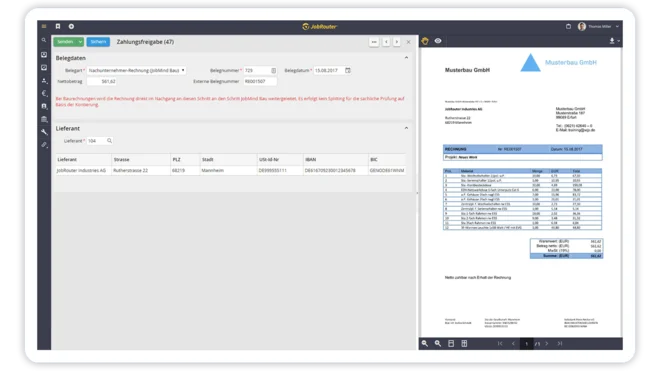
The integrated document management functions allow you to provide users with documents such as invoices, for example. Managers can check the details and then approve or decline the invoice. The process can be structured in such a way that the goods receipt document, the supplier’s quotation, or the supplier’s contract is displayed in addition to the invoice.
JobRouter® forms can be adapted using a low-code application to display everything a user needs to make a decision.
Managing users and rights
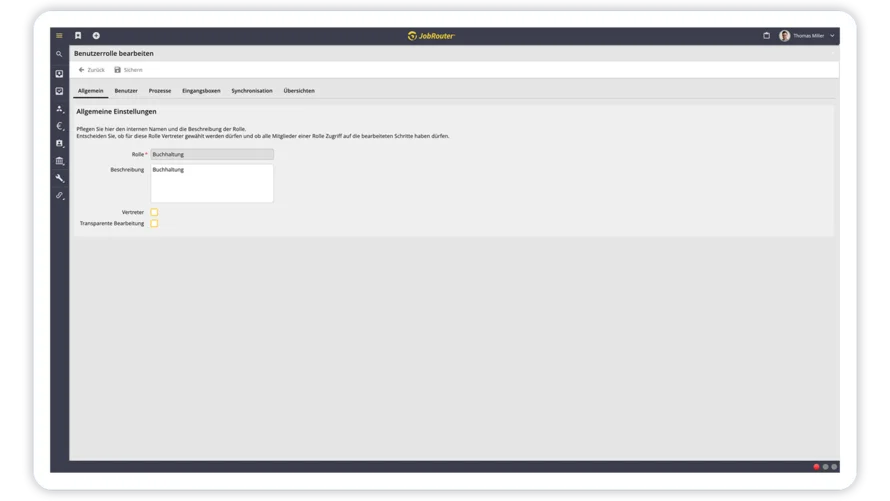
The user and rights management option integrated in JobRouter® allows you to control access to your processes and applications developed with low-code individually. This means that you will benefit from role assignment and integration with existing directory services such as Active Directory.
Testing applications directly
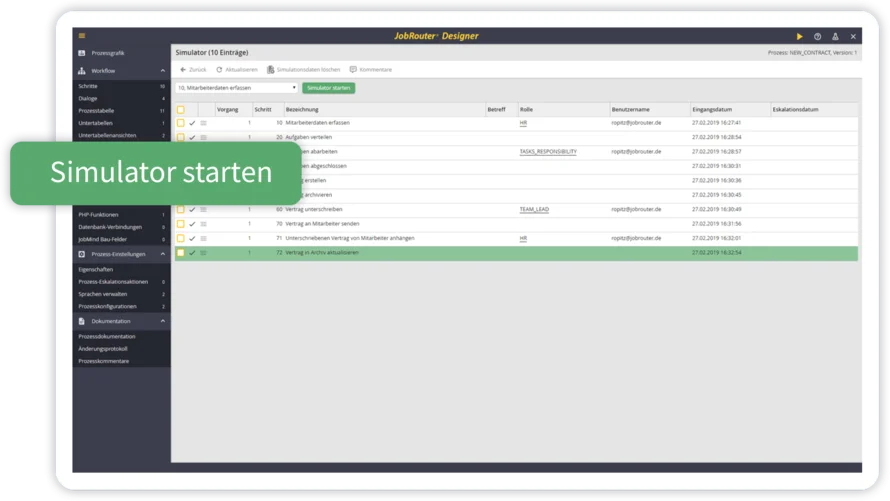
You can immediately test your processes and applications and monitor established business rules with the integrated simulation environment. This allows you to check the workflow logic as it is being created.
Identifying and analyzing weak spots
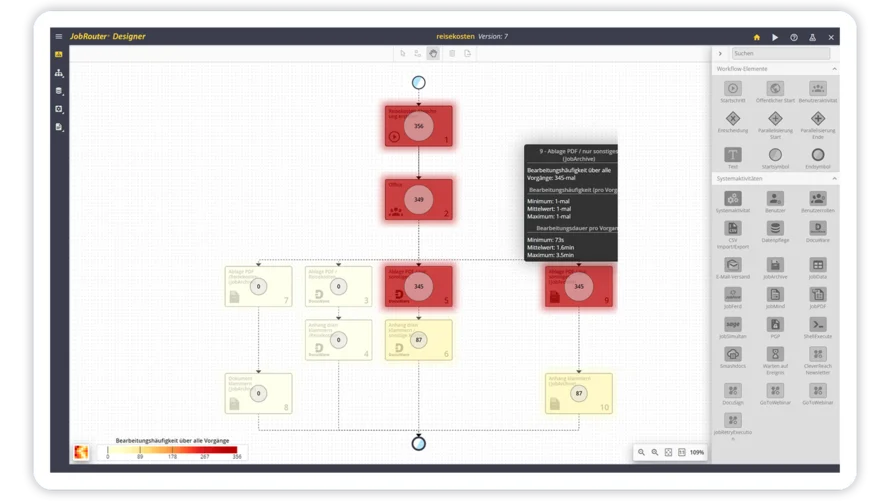
You can also see the average processing times corresponding to individual process steps. This information helps you to create new versions of your processes.
Low code for digital processes in companies
Who Can Benefit From Low-Code Process Design?
All departments in a company can benefit from a low-code programming solution such as JobRouter®, from users to process designers, process managers and developers. Regardless of which group you belong to, JobRouter® will support you with a variety of functions, modules, and interfaces with standard systems. You can also add more functions to the platform thanks to low-code.
Users
Users benefit from low-code development as the necessary processes and applications can be made available very quickly. They can use the individually created solutions and participate in workflows whenever and wherever they choose.
Process designers
Process designers create business apps and digital workflows. They would like to have access to software that allows them to design processes with simple drag and drop tools whilst also having the option of displaying more complex individual workflows. A low-code application covers both requirements.
Process managers
Process managers get an overview of all business processes in the low-code software and create analyses as required. A low-code application allows process managers to become programmers themselves and intervene actively if necessary.
Software developers
The job of software developers is made easier with low-code development, as they only need to support more complex workflows. They can develop individual interfaces or modules.
Give it a Try: Discover JobRouter®
JobRouter® combines low-code development with process automation in a unique way:
- Process designer for visual modeling
- Can be used on the desktop or from the Cloud as a mobile solution
- Process graphs are based on BPMN 2.0 design
- Marketplace for process templates, add-ones and system activities
- Maximum security: ISO 27001 certified data centers, all requirements from GoBD and DSGVO
- Integrated document management with archive functions
FAQ : Frequently Asked Questions About Low-Code Development
What is the difference between low-code and no-code?
In general, compared with low-code, no-code does not require any coding. No-code platforms are the easiest to operate. However, they lack flexibility. Due to the predefined design, it does not allow for customization and processes can only be mapped to a limited degree according to personal requirements. When choosing between no-code and low-code, managers therefore have to weigh up how customized they want to map their own process landscape.
What effect does low-code have on optimizing my business processes?
Low-code accelerates the digitization and automation of your business processes by up to 90%, while simultaneously reducing costs significantly and improving process quality.
How does this work specifically? With low-code platforms, you can model processes using drag-and-drop instead of having to program them. Your subject matter experts, who know the processes best, create digital workflows themselves – without having to wait for IT. Recurring tasks such as approvals, data entry, or status updates run automatically.
The measurable effects:
- Time savings: Processes that take days today run in hours
- Error reduction: Automation eliminates manual input errors
- Transparency: Real-time insight into all process steps and bottlenecks
- Scalability: Processes grow seamlessly with your business
- Integration: Existing systems (SAP, Salesforce, etc.) are seamlessly connected
What is a low-code digitalization platform?
A digitalization platform enables companies to create end-to-end digital processes and individual business applications. This kind of platform provides an environment in which applications can be created and business processes modeled as well as a working environment (digital workplace) in which users can comfortably complete process tasks or use applications.
A digitalization platform based on low-code development requires minimal programming knowledge in order to digitalize initial business processes. Process designers can, for example, gain access to user administration, business process logic, rights management, digital forms, integrated translations, localization, and many other existing functions with JobRouter®.
What do I need to consider when choosing a low-code tool?
To make sure that you choose the right low-code platform, you should consider the following questions:
- Does the low-code platform include all the features and functions required for the planned digitalization project?
- Is the platform continually being optimized and developed?
- Is the platform flexible enough to allow for the implementation of unforeseeable requirements at a later stage?
- Are there standard interfaces with existing systems (e.g., SAP)?
- Are document processing functionalities already integrated in the platform or do separate systems need to be connected for that purpose?
Is low-code also suitable for small companies?
Yes. Low-code is suitable for companies of all sizes and in all branches. Low-code development is versatile and can be used whether you want to process your invoices or manage your contracts digitally.