Digitalization in Companies - What Does it Mean?
The digitalization of companies is moving forward relentlessly. But what do terms such as digitalization and digital transformation actually mean? Why should you address enterprise digitalization? How do you determine your current maturity level, and which digitalization measures are suitable for your company? This article provides comprehensive answers and tangible real-world examples.
General Definition: : What Is Digitalization?
Digitalization originally refers to the conversion of physical data into digital data. A classic example is scanning a paper document. However, the meaning of the term has changed over the years.
Today, digitalization is an umbrella term for the modernization of all aspects of business and private life. This modernization process is driven by the increasing use of digital technologies and information across society, the economy, public institutions, and politics.
When we talk about digitalization today, we usually mean the integration of digital technologies into processes, products, and services—with the goal of optimizing them.
Digital Transformation vs. Digitalization in Companies: What Is the Difference?
The terms “digitalization” and “digital transformation” are often used synonymously. On closer inspection, however, there are differences. “Digitalization” usually describes a specific process that uses digital technologies. In digital transformation, companies convert their analog processes and business models into digital ones.
Characteristics of digital transformation include:
- Inevitability: Companies cannot solve future challenges without digital technologies.
- Irreversibility: Digital technologies have become indispensable.
- Speed: The transformation process is advancing very quickly, requiring companies to continuously reinvent themselves.
- Uncertainty: It is difficult to predict which digital technologies will prevail in the future.
What Is Digitalization in Companies?
In the context of companies, digitalization enables a comprehensive transformation process. New technologies drive digital change and affect all areas of the business.
Enterprise digitalization influences business and production processes, work models, analytics, products, services, information management, the way customers are engaged, and even entire business models.
Well-thought-out process management, simple implementation, high time savings - JobRouter® is ideal for us.

Site IS Manager at Spheros Germany GmbH

Spheros Germany GmbH
Spheros is a global technology company and market leader in the development and manufacture of
thermal management solutions for all city and coaches, refrigerated transport fleets, and other commercial vehicles.
How Does Digitalization Change Companies?
Digitalization has far-reaching effects on companies. When companies use digitalization in a targeted way, it can reduce costs, optimize processes, enable flexible organizational structures, increase customer focus, open up new market opportunities, and create a high level of information transparency.
Enterprise digitalization triggers the following changes:
- Business models are enhanced with digital services for the benefit of customers.
- Flexible work models emerge, such as mobile and hybrid work.
- Information and documents are available anytime and anywhere.
- The production of goods is increasingly autonomous, controlled by digital technologies.
- Internal and external communication takes place across a wide range of digital channels.
- Decisions are increasingly made based on data, or big data.
- Business processes are mapped and automated in software to relieve employees.
Let’s now look at a few examples of enterprise digitalization to make these points more concrete.
Examples of Digitalization: : In Which Areas Can Companies Digitalize?
Every department in your company has digitalization potential. This applies to marketing and customer communication just as much as to internal communication, task management, logistics, and internal business processes. To illustrate this, we would like to introduce five specific use cases in this section.
Digital Mailroom
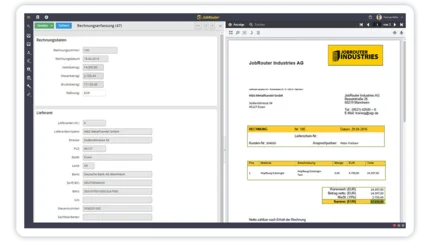
A classic example of enterprise digitalization is the digital mailroom. Your company likely receives a large number of invoices in different formats every day. These need to be received, stored, checked, approved, posted, and paid by your organization. Many individual steps are involved. However, by combining digital technologies in a targeted way, you can digitalize the process end to end.
Relevant components for digitalizing the mailroom include:
- Multi-channel input, enabling invoices to be received in all media and formats
- Document recognition (OCR) and content extraction
- Automated validation mechanisms
- Review and approval workflows
- Data transfer to the ERP system through interfaces
- Audit-proof archive
Ideally, full workflow automation can even be achieved, meaning human intervention is only required in cases of uncertainty or when defined value limits are exceeded.
Digital Contract Management
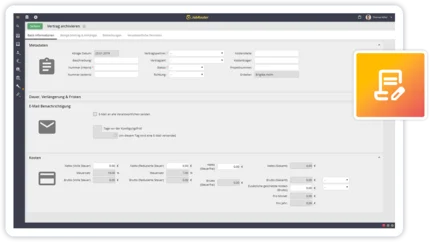
Digitalizing contract management is primarily aimed at companies that enter into contracts with customers every day and then want to manage them efficiently. From a functional perspective, this involves much more than simply archiving paper documents digitally.
Relevant features include:
- Automatic generation of contracts
- Central management and archiving
- Automatic capture of contract data and changes
- Digital deadline monitoring to ensure important dates are met
- Options for searching contract content using keywords
- Automatic sending of cancellations or reminders
Digital Document Work in Teams
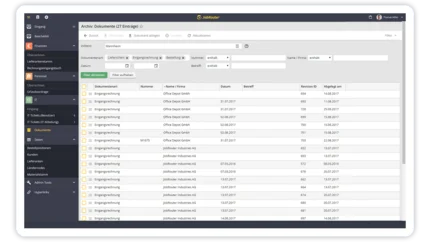
A central building block of the digital transformation of companies is creating a paperless office with digital processes. Digital document work is particularly relevant for communication and collaboration in distributed teams. However, simply introducing a document management system and a digital archive in your company is not enough. Ideally, you should also connect digital documents with your business processes. If this succeeds, employees always have access to the documents they need for their current work step.
Digital HR Processes
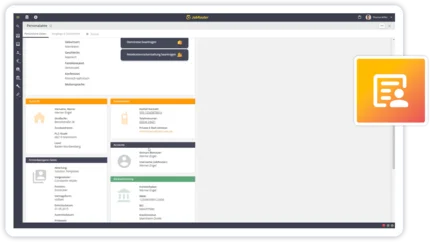
There are also numerous elements and processes in human resources that are relevant to enterprise digitalization—for example, the personnel file. For many HR managers, digitalization in HR is the starting point for a comprehensive digital transformation.
In fact, a digital personnel file offers many advantages. It allows all employee-related documents, such as application documents, payroll statements, and certificates, to be managed in one central location. If it is connected to important HR processes, you can even trigger these processes directly from the file. In our checklist, you will find many examples of digitalization in the HR department and can check your current status at the same time.
Digitalization of Incoming Invoice Processing
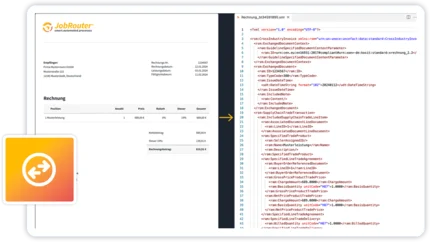
Every company works with invoices that need to be created or paid. Since digital signatures are now widely used and legally compliant, the step toward fully digital and partially automated invoice processing is only logical. Starting January 1, 2025, the e-invoicing mandate in B2B therefore defines the criteria for digitalizing incoming invoice processing.
Relevant measures for digitalizing invoice processing include:
- Multi-channel invoice input, such as email, portal, mail, and fax
- Reading e-invoices in XML format, such as ZUGFeRD or XRechnung
- Reading digitized invoices using OCR and artificial intelligence
- Automated matching of purchase order and invoice data
- Review and approval workflow
- Data transfer to the accounting system through interfaces
- Audit-proof archive
Companies should ensure that all exceptions and potential legal changes are taken into account during digitalization. If these are not reflected in the digitalized process, media disruptions, inefficiencies, and costly adjustments may occur again. In our checklist, you can check whether you are already sufficiently prepared for the mandatory introduction of e-invoicing.
Digitalization of Administrative, Non-Value-Adding Processes
Every company has processes that neither have direct customer relevance nor contribute to value creation. Examples include requesting and settling business travel, vacation requests, sick leave notifications, and onboarding new employees. These support processes are often handled using paper or various isolated solutions. This creates system breaks, a lack of transparency, and unnecessary effort. When digitalizing your company, you should therefore not overlook this area. Ideally, you should use a central workflow management system that allows you to map all your non-value-adding processes end to end.
Webinar recording : How Process Automation Works – Different Use Cases & Industries
What Do Business Processes Have to Do with Digitalization?
Enterprise digitalization has several dimensions. It can affect the business model, products, and services. Behind each of these elements are business processes that are also subject to digitalization. In short: enterprise digitalization is always linked to process digitalization.
Before starting comprehensive digitalization initiatives, you should assess where you currently stand. To do this, it is helpful to divide your existing processes into the following four digitalization categories:
- Completely manual: paper-based, with conversations taking place in person or by phone
- Software in use, but the workflow remains manual: the process is supported by business software, emails, intranet, databases, and similar tools
- Workflows are software-supported and activities are partially automated: for example, helpdesk ticket systems or predictive machine maintenance
- Process is fully digitalized and automated: human intervention is no longer required
Your short-term goal should be to bring every process to at least category 2. The most important aspect here is connecting the systems involved in order to create end-to-end workflows.
In the medium term, more and more workflows should move into the third category—in other words, they should be automated step by step. Advanced technologies such as IDP (Intelligent Document Processing), DPA (Digital Process Automation), and artificial intelligence are helpful for this.
In the long term, you should aim to move your company’s processes into the fourth category: full workflow automation. The guiding vision here is a completely digital company. From today’s perspective, it is impossible to predict whether and when this vision will become reality. The fact remains, however, that companies will continue to move closer and closer to this ideal.
Looking Ahead: : What Does a Fully Digital Company Look Like?
In theory, digital transformation has a defined end point: a completely digital company. Of course, this is still a vision for most companies. Nevertheless, it can be inspiring to consider it today. What might a fully digital company look like?
A digital company is characterized by the following features:
- All business processes are fully data-driven.
- Corporate planning is calculated automatically based on defined targets.
- The company aligns itself strategically using big data, including historical patterns, market trends, economic conditions, and sentiment in internet channels.
- Production is fully automated, including maintenance and logistics.
- Customer communication takes place via AI agents and chats.
- Advertising is personalized and automated.
- Decisions are made autonomously by AI based on learned patterns and are documented.
- Procurement is fully automated.
- Requirements are calculated and forecast independently.
- Purchasing takes place via bidding platforms, with automated selection of the best supplier.
- Machines and software processes are continuously monitored.
A fully digital company can increase its efficiency and productivity almost exclusively through the continuous optimization of the software it uses. The central competitive factor will then be the creativity with which companies realize innovations and differentiate themselves from the competition.
Maturity Model for Digital Processes: How to Determine Your Status
After this brief look into the digital future, let us return to the present and clarify how you can determine the current digital maturity level of your processes. This is important for planning further digitalization measures in a targeted way. In this context, the maturity model of the industry association Bitkom is recommended. It evaluates digital maturity across the following dimensions:
The maturity model is relatively easy to apply. It is well suited for evaluating the status quo holistically. Based on the results, you can derive which measures make sense for the further digitalization of your company.
Conclusion: : Digitalization of Companies Has Many Facets
To summarize: The digitalization of companies is multifaceted. In addition to business models, products, and services, it primarily affects your business processes. Or, to put it another way: enterprise digitalization is always synonymous with process digitalization.
To make progress in this area, several requirements must be met. First, you should know the current digitalization status of your workflows. On this basis, you can optimize your business processes organizationally and then transfer them into the digital world. For this final step, you need suitable technologies.
A digitalization platform that is easy to implement and highly scalable, and that enables the end-to-end digitalization of your business processes, is recommended. One solution of this kind is JobRouter®. The advantage of a low-code platform is that it does more than simply map your workflows. It also ensures cross-system connectivity. In addition, it supports workflow automation, helping you sustainably increase your competitiveness.